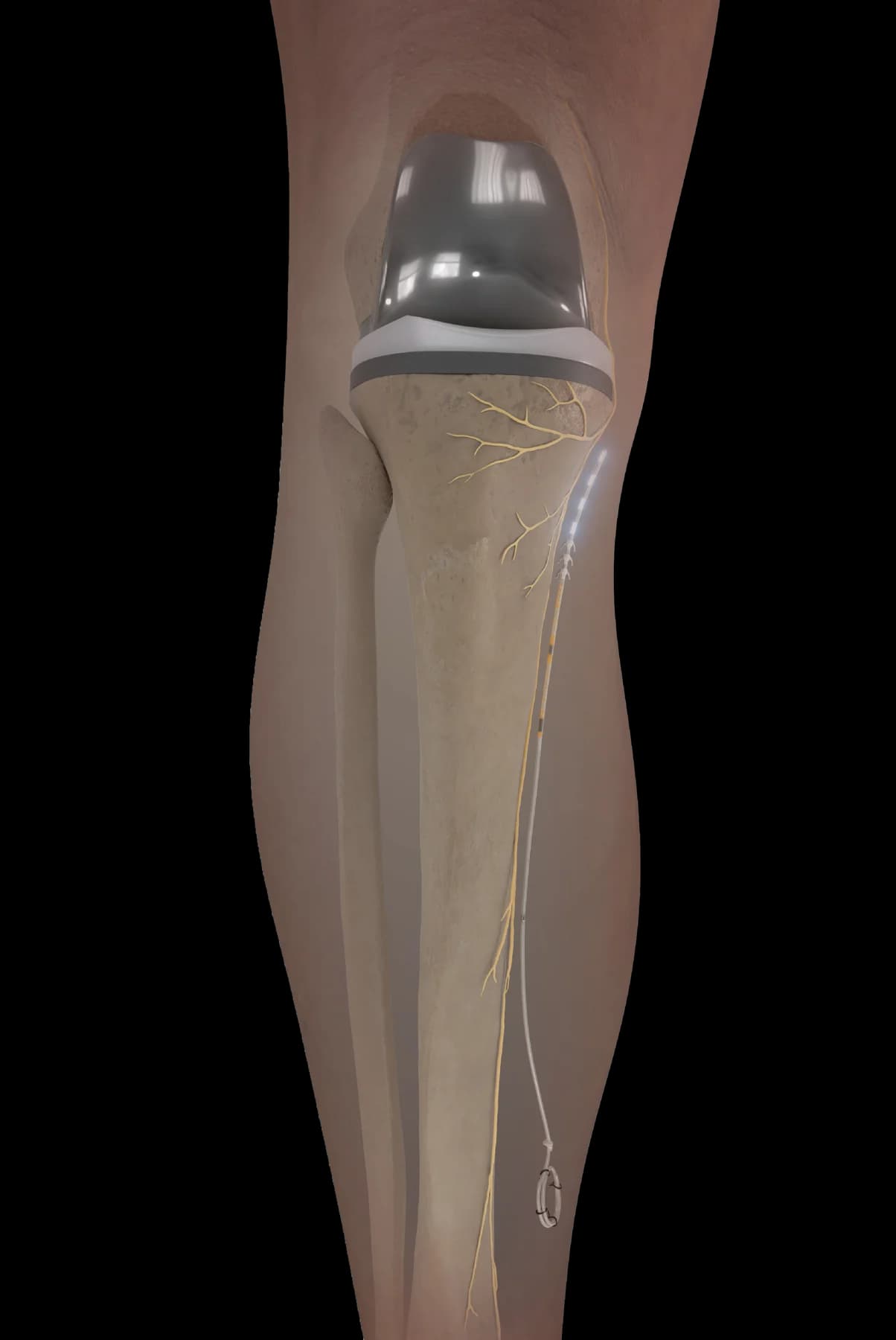
Knee
Infrapatellar saphenous nerve
Tell your physician if pain has continued after knee surgery, including total knee replacement, ACL repair, arthroscopy, tibial nail placement, or tendon harvest.
Curonix Freedom® PNS System
The Curonix Freedom® Peripheral Nerve Stimulator System uses electrical stimulation near a specific nerve to help interrupt pain signals. If other treatments haven’t helped enough, ask your physician whether PNS is an option for you.
For adults with severe, intractable chronic pain of peripheral nerve origin. A physician evaluation and trial help determine whether therapy is right for you. Results vary.

Your goals for treatment
Work toward less pain and more active days.
Understanding your pain
Pain that lasts longer than three months is considered chronic. Finding its cause helps your physician decide which treatments may help you sleep, move, and manage daily activities more comfortably.

Burning, tingling, stabbing, numbness, aching, or throbbing can have several causes. Peripheral nerves carry signals between your body and brain; an injury or previous surgery can affect them. Your physician assesses whether a nerve is contributing to your symptoms.
Tell your physician about medicines, creams, physical therapy, injections, or surgery, including what helped and for how long. Nerve blocks and radiofrequency ablation are other options for some patients. Treatment depends on the source of the pain.
If severe pain comes from a peripheral nerve and other treatments have not helped enough, your physician may discuss PNS. The system uses electrical stimulation near that nerve. An evaluation and a trial help determine whether to consider a permanent implant.
How it works
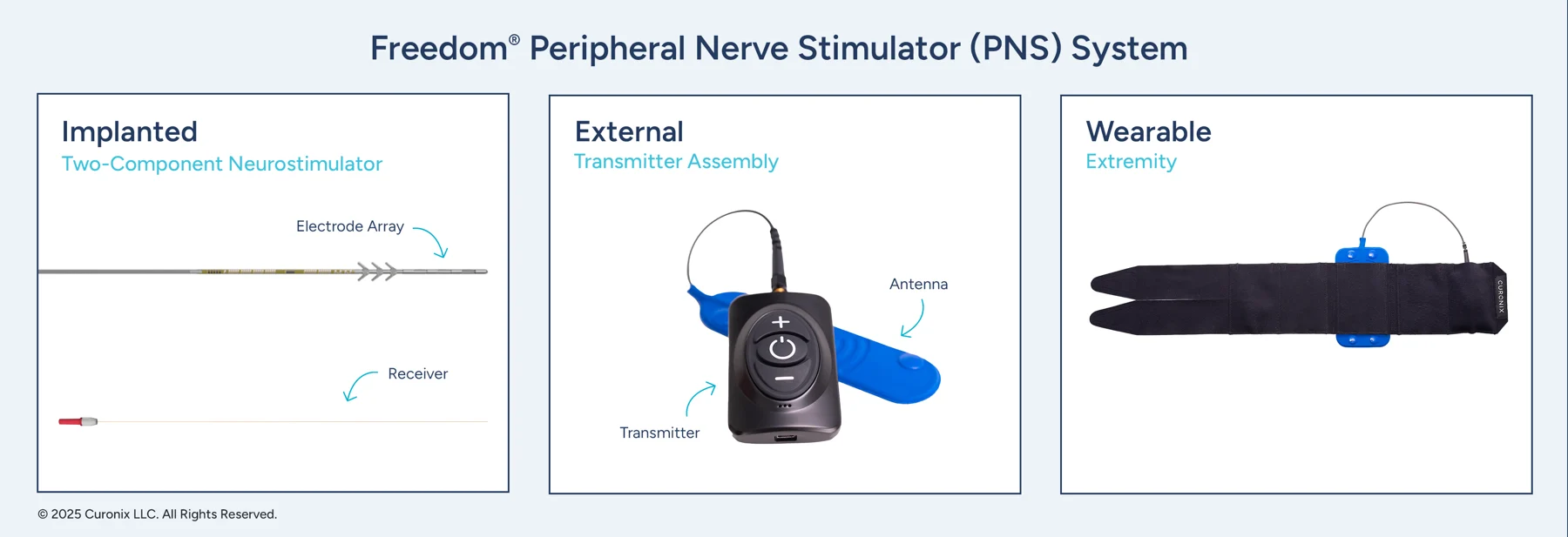
Freedom PNS uses implanted components powered by an external transmitter. The therapy is non-drug and non-opioid, cleared for use in the U.S., and placed through a minimally invasive procedure that is typically outpatient.
01
A thin electrode array and connected receiver sit beneath the skin. Electrical stimulation at a targeted peripheral nerve helps interrupt pain signals traveling toward the brain.
02
The transmitter powers the antenna, which sends power and signals to the implanted stimulator. Your care team personalizes therapy and teaches you how to operate the system.
03
An extremity, torso, or upper-torso wearable holds the transmitter assembly over clothing. Your treatment location and care plan determine the style and fit.
Using your system
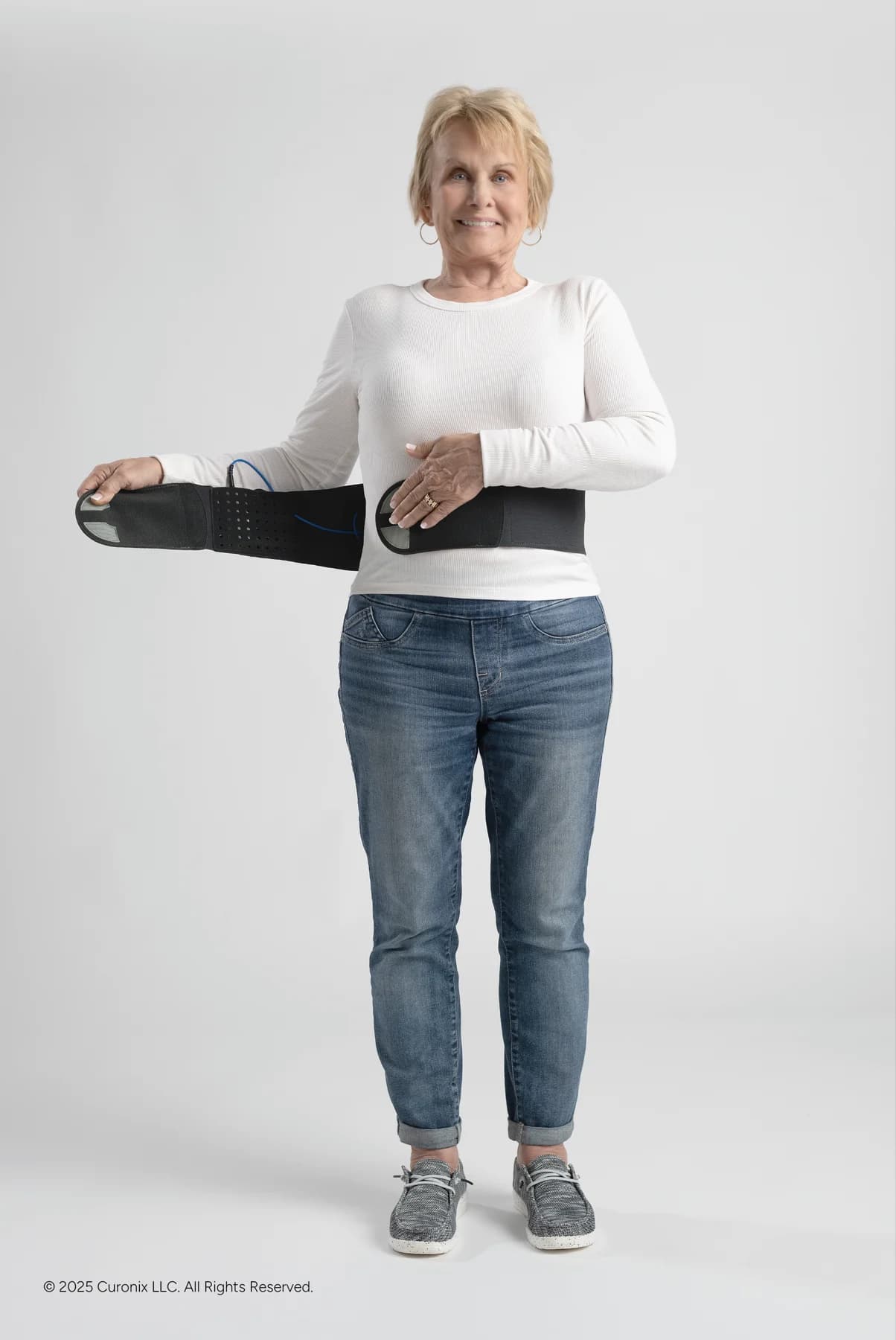
After permanent implantation, your Curonix representative helps size the wearable. Your team provides instructions for charging, positioning, therapy settings, incision care, and activity. Follow those instructions as you recover and return to daily activities.
Living with Freedom PNS →Pain areas
The placement depends on which nerve is involved. These Curonix illustrations show examples for different areas of the body. Pain location or a past surgery alone does not determine eligibility; your physician evaluates the diagnosis, nerve, and device labeling for your case.
Infrapatellar saphenous nerve
Tell your physician if pain has continued after knee surgery, including total knee replacement, ACL repair, arthroscopy, tibial nail placement, or tendon harvest.
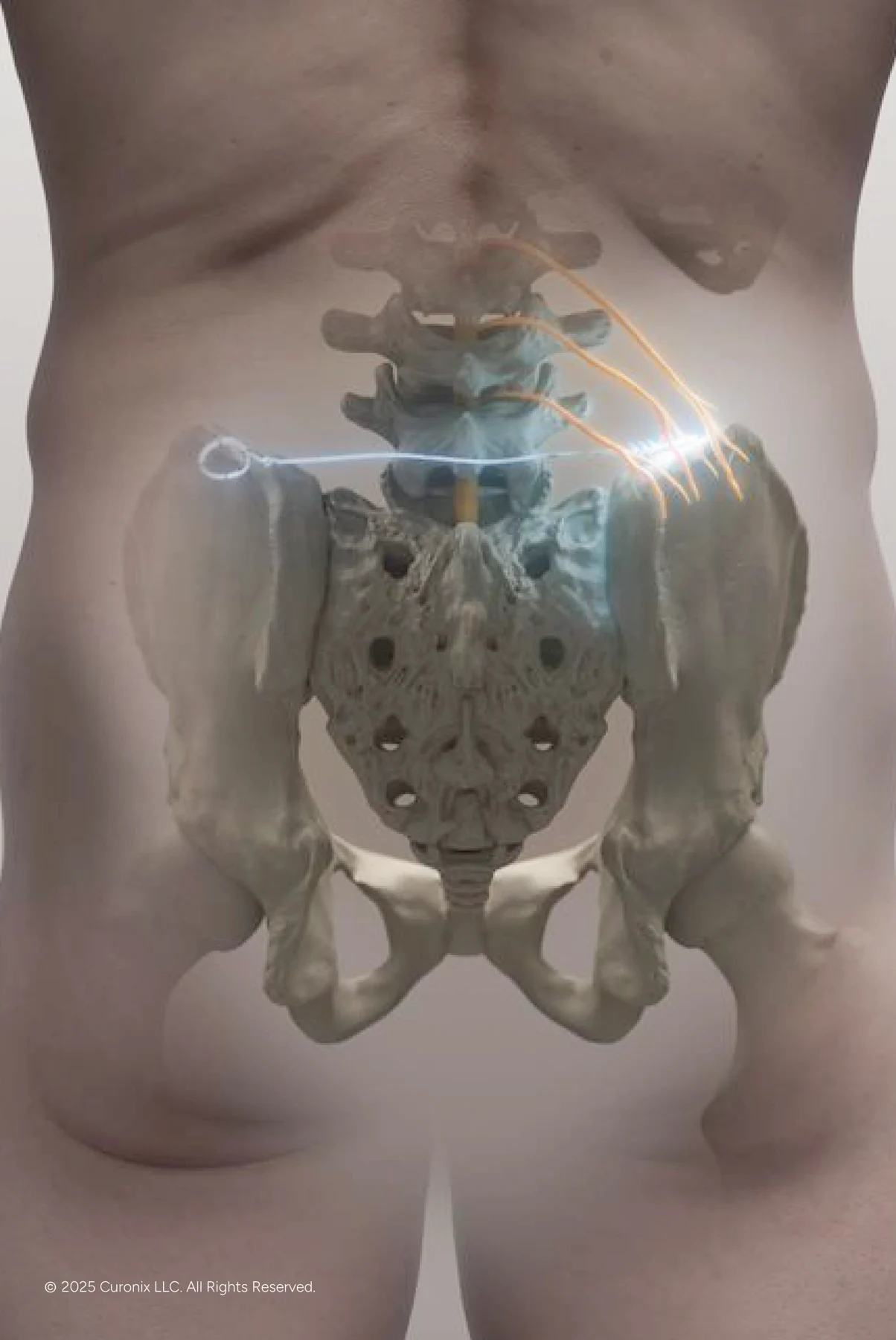
Superior and middle cluneal nerves
Buttock or gluteal pain, tenderness near the sacroiliac joint, pain with sitting or changing positions, and low back pain extending into the leg can have different causes. An exam helps identify whether a peripheral nerve is involved.
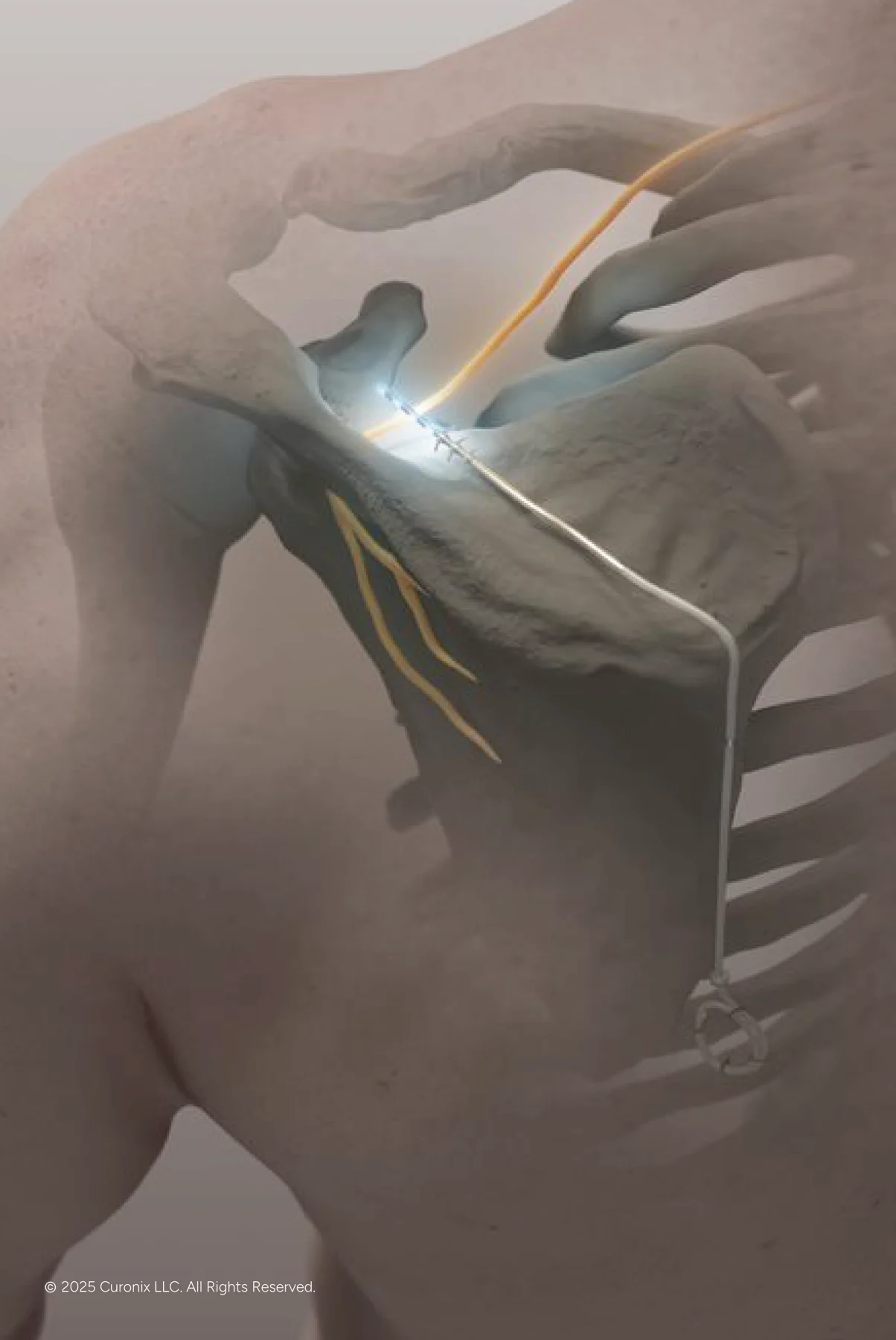
Suprascapular nerve
Ask for an assessment if you have limited arm movement, a frozen shoulder pattern, pain raising an arm, or pain radiating down the arm. Your physician will need to determine the cause before recommending PNS.
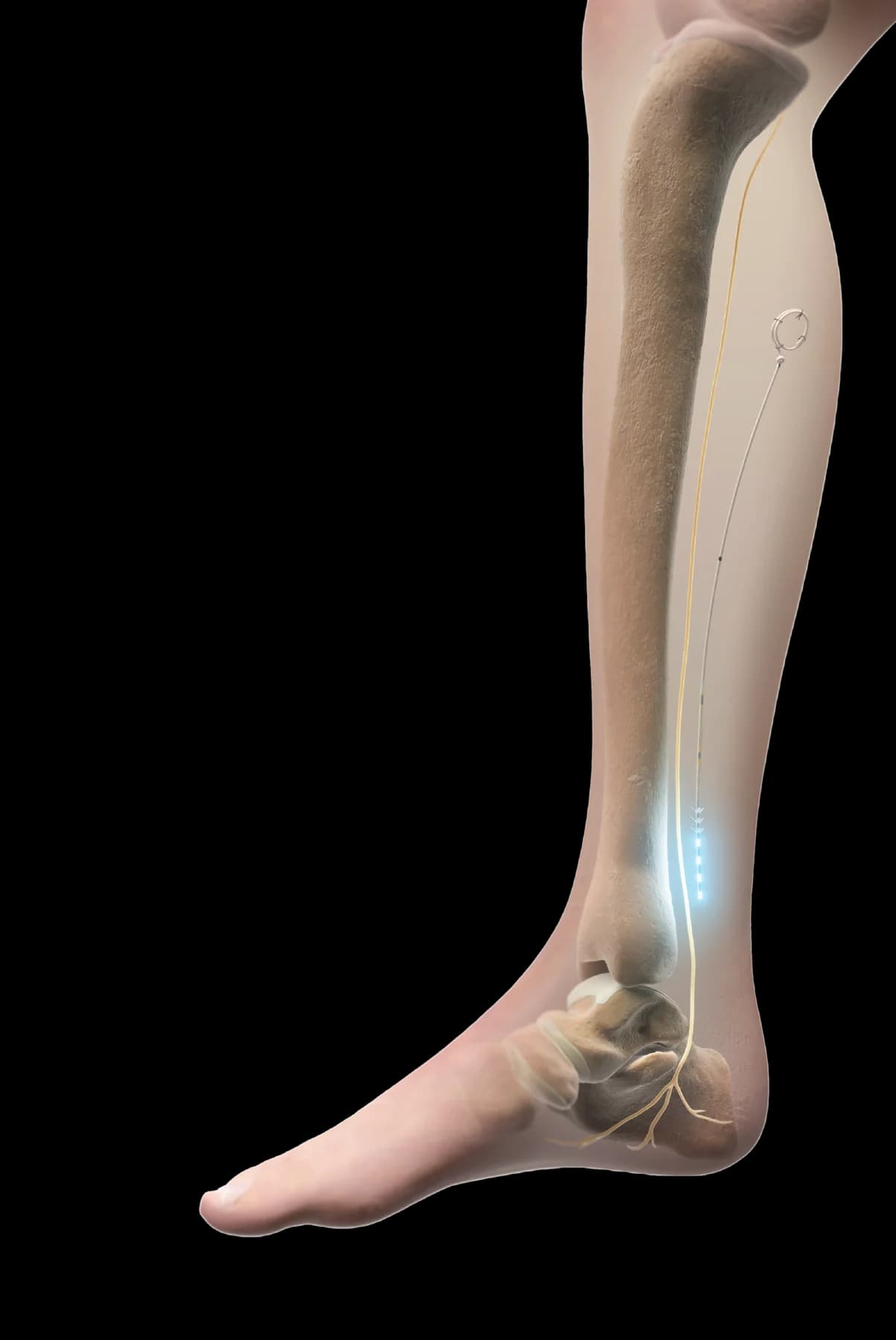
Posterior tibial nerve
Discuss pain in the sole or toes, ankle pain, difficulty walking, or sensitivity to touch or weather changes with your physician. Mention any pain that has continued after tarsal tunnel repair.
The patient brochure also discusses head and neck, arm and wrist, and leg pain. Head and neck symptoms may include pain radiating down the neck, pain at the base of the skull, facial pain, or sensitivity to touch and temperature. Ask your physician which options fit the cause of your symptoms and which device labeling applies.
Read the pain-area guide →Evaluation and treatment
Once your physician has assessed the cause of your pain and discussed your options, a trial helps you see how PNS affects your symptoms and daily activities. Here is what the process involves.
Complete a patient profile with your medical history, symptoms, previous treatments, and personal goals. Think about what pain keeps you from doing.
A physical and psychological assessment helps your team understand your pain, its effect on daily life, and whether a peripheral nerve stimulator is appropriate.
A temporary trial lets you and your healthcare team evaluate pain relief, function, and well-being before deciding on a long-term implant. Your team sets the trial schedule and activity restrictions.
After a successful trial, discuss permanent implantation, recovery, and device training. Your Curonix representative helps fit the wearable accessory. Your care team adjusts therapy and arranges follow-up.
Benefits, risks, and practical questions
Before deciding on a trial or permanent implant, review the benefits, risks, MRI restrictions, and costs with your physician. These answers can help you prepare for that conversation.
Read the MRI guide →It is a prescription system from Curonix for adults with severe, intractable chronic pain of peripheral nerve origin. An implanted stimulator sends electrical stimulation to a targeted peripheral nerve to help interrupt pain signals. It may be used alone or as part of a broader treatment plan.
The implanted stimulator is powered by an external transmitter and antenna. A wearable accessory holds the transmitter assembly over clothing. Your team explains placement, charging, and the settings prescribed for you.
A trial comes before permanent implantation. You and your physician review how well it helps your pain and daily function. If the trial helps enough, you can discuss a permanent implant. Long-term results vary.
The therapy itself is non-drug and non-opioid. It may be used alongside other treatments. Keep taking medication as prescribed and discuss any changes with your treating clinician.
The system is placed through a minimally invasive procedure, typically in an outpatient setting. It still involves an implant procedure and carries risks. Your physician explains anesthesia, incisions, recovery, and alternatives for your situation.
Certain permanent Freedom PNS configurations are full-body MR Conditional at 1.5T and 3T, only under the manufacturer's exact conditions. Trial devices are MR Unsafe. Have the implanting team and imaging center verify your model, implant location, and current MRI instructions before scheduling a scan. External transmitter equipment must stay outside the MRI room.
Tell your physician about implanted cardiac devices, infection, blood thinners, pregnancy or nursing, difficulty operating the system, and exposure to strong electromagnetic fields. Diathermy can cause serious injury with an implanted system. Your physician must review the complete contraindications and warnings for your device.
Risks include infection, bleeding, pain at the implant site, nerve injury, movement or damage of the implanted components, uncomfortable stimulation, device problems, and inadequate pain relief. Additional procedures may be needed. Ask your physician to review the complete product labeling with you.
Coverage and out-of-pocket cost depend on your insurer, diagnosis, planned procedure, and any prior authorization requirements. Ask our office and your plan to verify coverage for both the trial and permanent implant before scheduling.

Manufacturer lifestyle imagery; not a Kentuckiana patient outcome.
Patient resources
To revisit what you have learned or prepare questions for your appointment, explore the captioned patient animation, a technology overview, a procedure animation, Spanish-language education, and four patient stories. Download the full brochure to read or share with someone close to you.
Louisville & Radcliff, Kentucky
Tell us what you have tried and which activities pain makes difficult. Our team can help you decide whether to consider Freedom PNS.
Our phones are answered 24/7.
Sources: Curonix patient brochure and approved web content. Updated October 16, 2026. Only a physician can determine appropriate treatment; individual results vary. Curonix LLC manufactures medical devices and does not practice medicine. This information does not replace a consultation or the full product labeling.
Patient brochure (PDF)Current manufacturer instructions & safety informationU.S. MRI instructions (PDF)
Freedom® is a registered trademark of Curonix LLC. Curonix imagery © 2025 Curonix LLC. All rights reserved.