
Nerve Procedures
Epidural Lysis of Adhesions
Epidural lysis of adhesions is a catheter-based procedure that breaks up scar tissue around spinal nerves, most often after back surgery. Freeing the trapped nerve can reduce pain directly and lets injected medication reach the area again, which is why it is considered when standard epidural injections have stopped helping.
Request an AppointmentWhat is Epidural
Lysis of Adhesions?
After spine surgery, injury, or inflammation, scar tissue can form around spinal nerves, irritating them, restricting them, or blocking medication from reaching them.
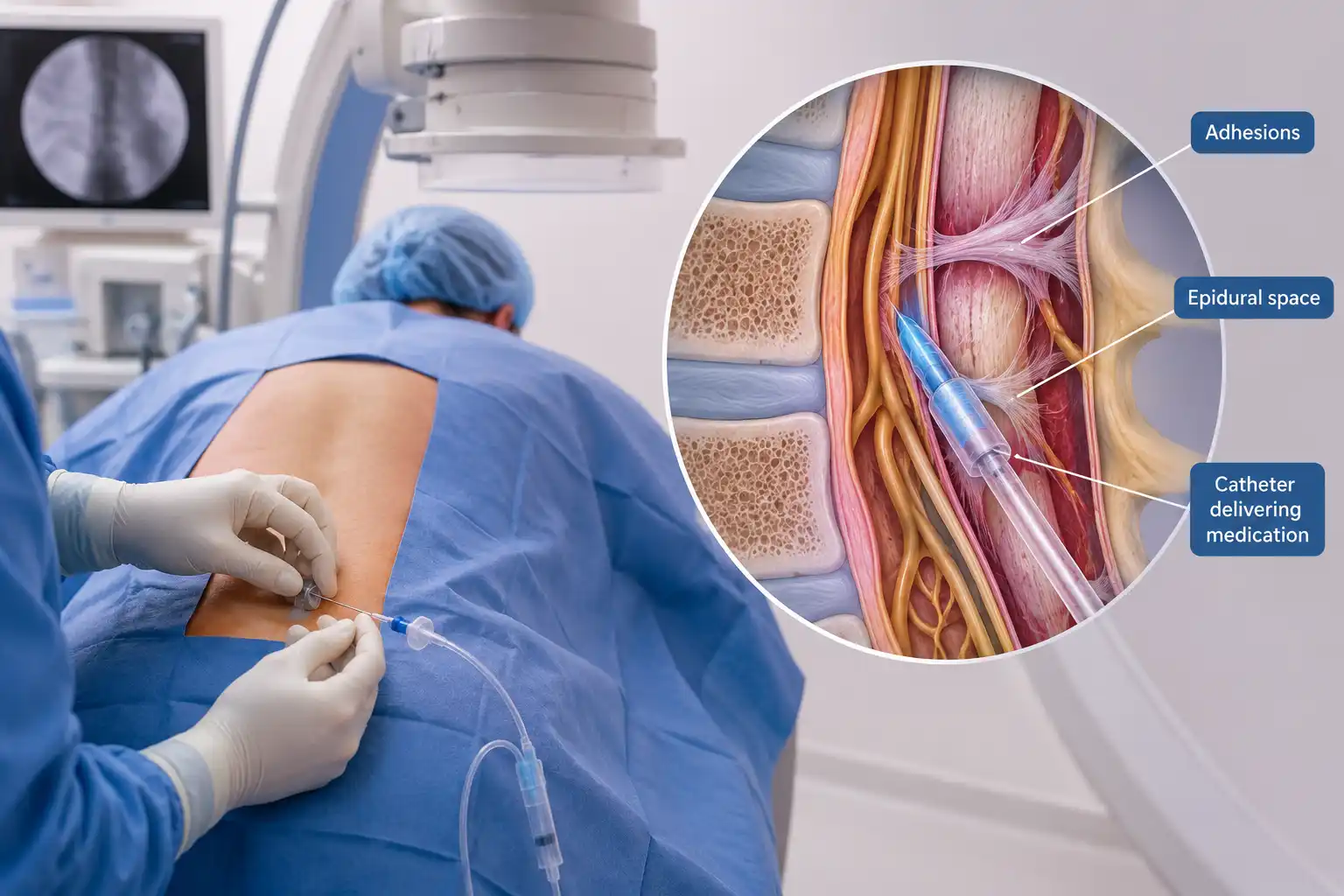
Epidural lysis of adhesions (also called epidural adhesiolysis) is a minimally invasive procedure that guides a small catheter into the epidural space, delivering medication precisely to the areas where scar tissue is interfering.
It's more specialized than a standard epidural injection, which simply places medication into the epidural space. The catheter reaches where scar tissue may be limiting medication spread, which is exactly why it's considered when standard injections haven't provided enough relief.
The goal isn't to remove scar tissue completely. It's to reduce irritation and improve medication access around the affected nerves, with the procedure performed under imaging guidance, the area cleaned and numbed, as an outpatient visit.
Dr. Nair reserves this procedure for carefully selected patients. Your symptoms, history, imaging, and prior treatment response determine whether scar tissue is likely the barrier.
A catheter reaches areas that scar tissue keeps standard injections from treating effectively.
The catheter is guided into the epidural space under imaging, delivering medication precisely to the affected area.
Catheter-based, with no incision, performed as an outpatient procedure with the area cleaned and numbed.
Considered when pain persists after spine surgery or when standard epidural injections haven't delivered enough relief.
Am I a candidate for epidural lysis of adhesions?
When standard epidurals can’t reach the nerve, a catheter can.
This is a specialized procedure and is not appropriate for every patient with back or leg pain. Your provider determines whether scar tissue is likely involved based on your symptoms, history, imaging, and prior treatment response. It may be considered for patients with:
Pain After Spine Surgery
Persistent pain following spine surgery.
Suspected Spinal Scar Tissue
Scar tissue suspected around spinal nerves.
Pain Traveling Down the Leg
Leg pain from nerve irritation.
Chronic Nerve Irritation
Ongoing irritation of spinal nerves.
Limited Relief From Epidurals
Pain not improved with standard epidural injections.
Failed Back Surgery Syndrome
Selected cases of failed back surgery syndrome.
Common questions about epidural lysis of adhesions
It is a specialized procedure that uses a small catheter in the epidural space to deliver medication near areas where scar tissue may be irritating spinal nerves.
What is Epidural Lysis of Adhesions?
It is a specialized procedure that uses a small catheter in the epidural space to deliver medication near areas where scar tissue may be irritating spinal nerves.
Ready when you are.
When Surgery’s Scars
Keep Hurting
If pain has persisted after spine surgery, or standard epidurals keep falling short, ask Dr. Nair whether scar tissue is the barrier, and whether this procedure can get past it.
Prefer to talk? Call (502) 995-4004, answered 24/7.
Medically reviewed by Ajith Nair, M.D., Founder & Medical Director at Kentuckiana Pain Specialists. This page is for education and is not a substitute for a personalized medical consultation.
Last medically reviewed July 2026Updated